
How to dehydrate & rehydrate sourdough starter
Drying your starter turns it into shelf-stable flakes: a backup in case anything happens to your jar, or a gift for a friend starting their sourdough journey. Here's how to dry it, store it, and wake it back up.
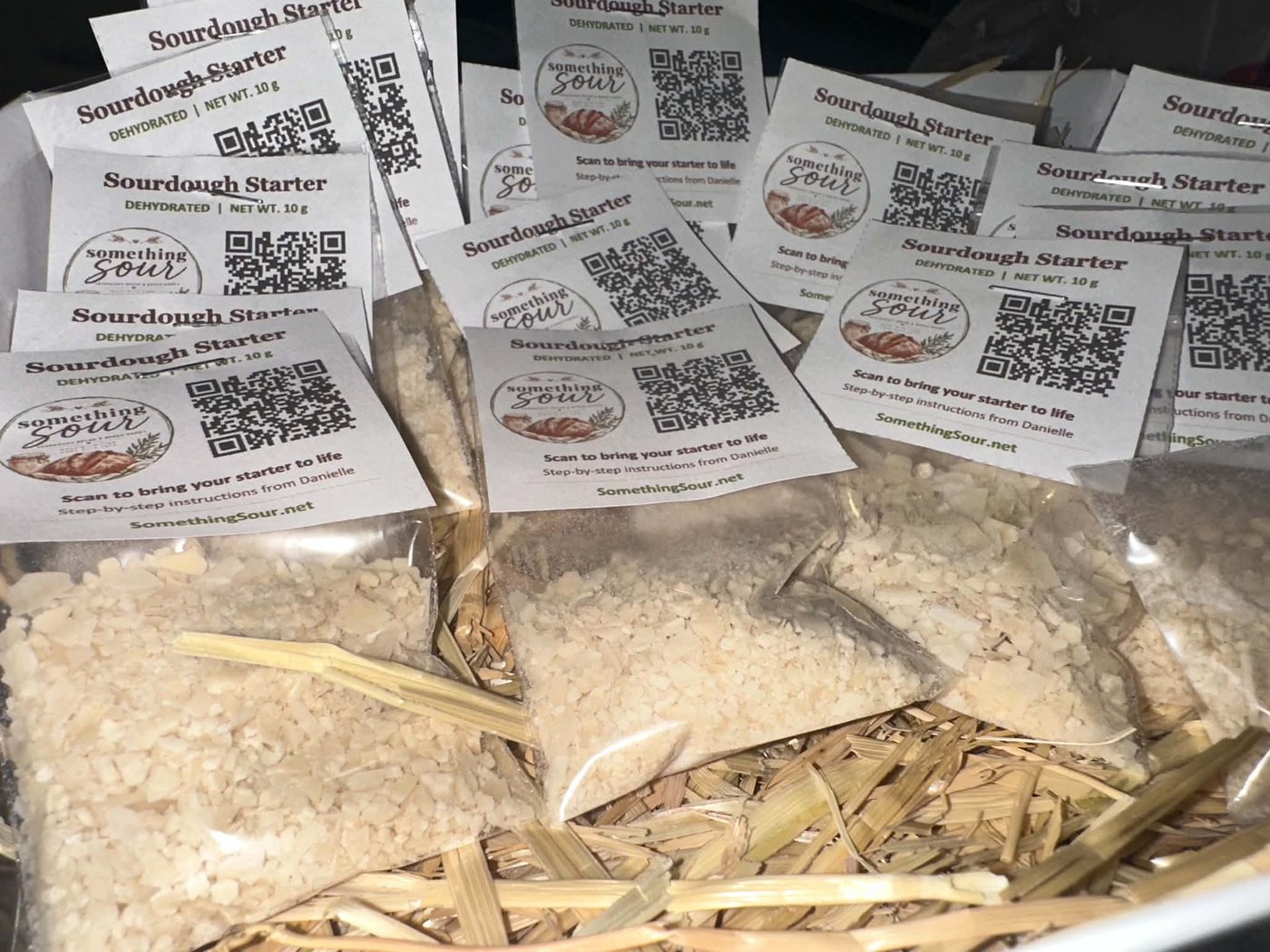
Why dry your starter?
A healthy starter takes time and patience to build, and it can be lost to a forgotten jar, a hot car or a long trip. A small stash of dried starter is cheap insurance: it keeps for months without feeding, and it comes back to life with just flour, water and a couple of days.
Dried flakes also travel well and make a thoughtful gift. Anyone can turn them into their own living starter at home.
How to dehydrate sourdough starter
-
Feed it and wait for the peak
Feed your starter as usual and let it rise until it has roughly doubled, with bubbles all through it. Dry it at its peak, when it's most active. If your starter has been living in the fridge, give it two feedings at room temperature first so it's fully awake.
-
Spread it paper-thin
Line a baking sheet with parchment. Use a spatula to spread the starter in a very thin, even layer. The thinner it is, the faster and more evenly it dries.
-
Let it dry completely
Air-dry: leave the tray somewhere dry, out of direct sun, for about 24–48 hours. To speed it up, put the tray in the oven with only the light on (oven off).
Dehydrator: use the lowest setting, around 80–90°F, for a few hours or overnight. Keep it under about 100°F: too much heat can weaken or kill the yeast and bacteria.
It's done when it's brittle and snaps cleanly, with no soft or tacky spots.
-
Break it into flakes
Peel it off the parchment and crumble it into small flakes, or pulse it briefly in a blender for a coarse powder.
Storing dried starter
Keep the flakes in an airtight jar or bag somewhere cool, dark and dry, like the back of a pantry. Kept dry, it lasts many months and often a year or more. Label the jar with the date, and if you're gifting it, tuck in a note about how to rehydrate it (or a link to this page).
What you need to rehydrate it
- Dried starter: about 10 grams (roughly a heaping tablespoon of flakes). Every Something Sour starter packet is exactly 10 g, so you can use the whole packet.
- Kitchen scale: weighing in grams makes this much easier.
- Flour: all-purpose or bread flour. A spoonful of whole wheat or rye helps it wake up faster.
- Water: lukewarm. If your tap water is heavily chlorinated, use filtered or bottled.
- A clear jar: a pint (16 oz) mason jar is perfect, so you can watch it rise.
- A rubber band or marker: to mark the level after each feeding.
- A warm spot: around 75–80°F is ideal. A thermometer is handy but optional.
How to rehydrate it, day by day
Dissolve, then feed
Add 10 g dried starter and 50 g lukewarm water to a clean jar. Close the lid and give it a shake every so often over 3–4 hours, until the flakes dissolve into a milky liquid.
Stir in 50 g flour, plus a splash more water if needed, to make a thick batter. Cover loosely, mark the level and leave it somewhere warm overnight.
Discard and feed
Morning: look for bubbles and a slightly tangy smell. Don't worry if not much happened yet. Keep 50 g of the starter in a clean jar and feed it 50 g flour + 50 g water. Mark it and keep it warm for about 12 hours.
Evening: if it has doubled and is bubbly, it may already be ready. If not, repeat the discard and feed.
Repeat until it's lively
Keep feeding morning and evening (50 g starter + 50 g flour + 50 g water) until it rises and falls on a predictable schedule. Most dried starters are back in 2–3 days. Cooler kitchens can take a little longer.
How to tell it's ready
- It roughly doubles within 4–8 hours of a feeding
- It's full of bubbles, top to bottom
- It smells pleasantly tangy and yeasty, not sharp or like nail polish
- It rises and falls on a schedule you can count on
Then it's ready to bake with. From here, feed it the way you'd care for any starter.
Dehydrate & rehydrate sourdough starter
To dehydrate
- Feed the starter and let it peak (doubled and bubbly).
- Spread paper-thin on parchment.
- Air-dry 24–48 hrs, or dehydrate at 80–90°F (under 100°F).
- Crumble into flakes. Store airtight, cool and dark.
To rehydrate
- 10 g flakes + 50 g lukewarm water. Dissolve 3–4 hrs.
- Add 50 g flour. Cover loosely and keep warm overnight.
- Keep 50 g starter. Feed 50 g flour + 50 g water every ~12 hrs.
- Ready when it doubles predictably and is bubbly.
Tip: a little whole wheat or rye flour in the feedings speeds things up. Keep the ratio the same if you use more or less starter.
Questions
I only have about 5 grams of dried starter. Will that work?
Yes. Just keep the same ratio and halve everything for Day 1: 5 g flakes, 25 g water, 25 g flour.
Can I store the flakes in a cloth bag?
An airtight jar or bag is safer. Dried starter needs to stay dry, and air and humidity invite mold and pantry pests.
I dried my starter after it had already peaked. Is it ruined?
Usually not. Starter dried slightly past its peak tends to come back fine; give it an extra day or two of feedings. Starter dried before it got active is more likely to be sluggish.
Day 2 and still nothing is happening. What now?
Move it somewhere warmer (75–80°F), add a little whole wheat or rye to the next feeding, and keep going. Temperature makes the biggest difference.
How long does dried starter last?
Kept airtight, cool, dark and dry, it lasts many months and often a year or longer.